
TUTSAN
Hypericum androsaemum

DESCRIPTION
Tutsan isn’t Tutu (some people confuse the similar names, but probably not the actual weeds themselves). Tutsan, also known as Sweet Amber, is a small, erect shrub, about 1.5m high. It’s a member of the same plant family as St John’s Wort.
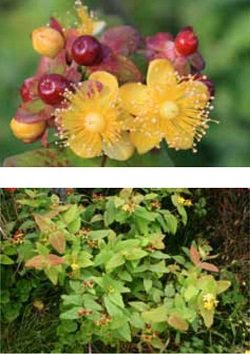
The Tutsan shrub is a perennial semi-evergreen with light-green, oval, fragrant leaves that turn reddish in the autumn. Leaf size is up to 100mm long and 50mm wide. Stems are woody, and usually reddish in colour.
From November to February the Tutsan produces yellow five-petalled flowers with long stamens, around 25mm in diameter. They grow at the end of the stems in close clusters of 2 to 8 flowers. Flowering is followed by the appearance of round (10mm dia) red berries that ripen to black.
The seeds (inside the berries) are spread by birds, as well as water, wind and soil-borne means. The seeds are numerous, long-lived and tolerant to environmental extremes, and so can survive and regenerate well after a site has been initially cleared.
Tutsan grows most actively around streams, tracks and roadsides, banks, excavated and disturbed areas, and in rough and lightly farmed pastoral land. It forms extensive and dense patches once it gets a start, smothering existing low-growing plants and spreading to invade adjacent productive land. It prefers cool, wet conditions and is reasonably tolerant to shade.
In some regions Tutsan is a ‘boundary control plant’ and must be controlled within 20M metres of the site’s boundary.
Tutsan is only mildly poisonous (probably just the berries), but is unpalatable to all stock because of the bitter taste.
MANUAL & MECHANICAL REMOVAL
Small plants can be successfully removed by hand-pulling. Larger stands of plants can be cleared by slashing, but spraying of regrowth will still be necessary. Removed material can be left on site to rot, but may be collected for burying or composting if preferred.
HERBICIDES TO CONTROL TUTSAN WEED
Cut & Stump Paint or Cut’n’Paste Gel to Kill Tutsan
This works best during spring and summer, when there is sufficient biological activity for the herbicide to get into the rest of the plant via the cut stump.
- MSF600 – 5g/L
Cut the plant off as low to the ground as possible, and liberally coat the stump with the herbicide mixture immediately after cutting, to ensure optimum herbicide penetration before the cut ‘heals’.
Alternately use Cut’n’Paste MetGel on the freshly cut stump. Clean and easy to apply.
Spot Treatment Herbicides to Kill Tutsan
- Buckshot applied dry at 55g per square metre sprinkled around the base of the plant and out to the drip line. The plant is then left to die standing. This is an excellent ‘target-of-opportunity’ treatment when carried on the bike or ute.
Spray Weedkillers to Kill Tutsan
This is the preferred method of control for larger infestations that are impractical to control by the other methods (above).
Slash larger plants and dense stands, and spray regrowth during spring or summer with:
- G-360 GLYPHOSATE – 1L/100L plus 100ml SuperWetter. If using G-540 GLYPHOSATE, make the rate 660ml/100L, plus the 100ml SuperWetter, or Granny Herbicide the rate is 450g/100L plus the 100ml SuperWetter.
- MSF600 – 35g/100L plus 100ml SuperWetter.
Foliar spray large stands without first slashing, during Nov-Jan only, with:
- GrassMate – 6ml/L by knapsack (i.e 90ml in a 15L knapsack). Add SuperWetter – 15ml/15L.
- MSF600 – 35g/100L by handgun, plus 100ml SuperWetter.
The preferred herbicide for spraying is MSF600 as it gives the best control with least regrowth. GrassMate is effective, and is grass-friendly, but more expensive. G-360 GLYPHOSATE, G-540 GLYPHOSATE or Granny Herbicide are slightly less effective, but remain a good choice if the other recommended herbicides are not on hand.
Cut'n'Paste Gel Herbicides to Kill Tutsan
- Cut'n'Paste MetGel applied as a 2-4mm thick layer of herbicide paste on the cut stems is a simple and effective control. Note: metsulfuron methyl based herbicides like MSF600 or Cut'n'Paste MetGel have a reasonably long kill time.