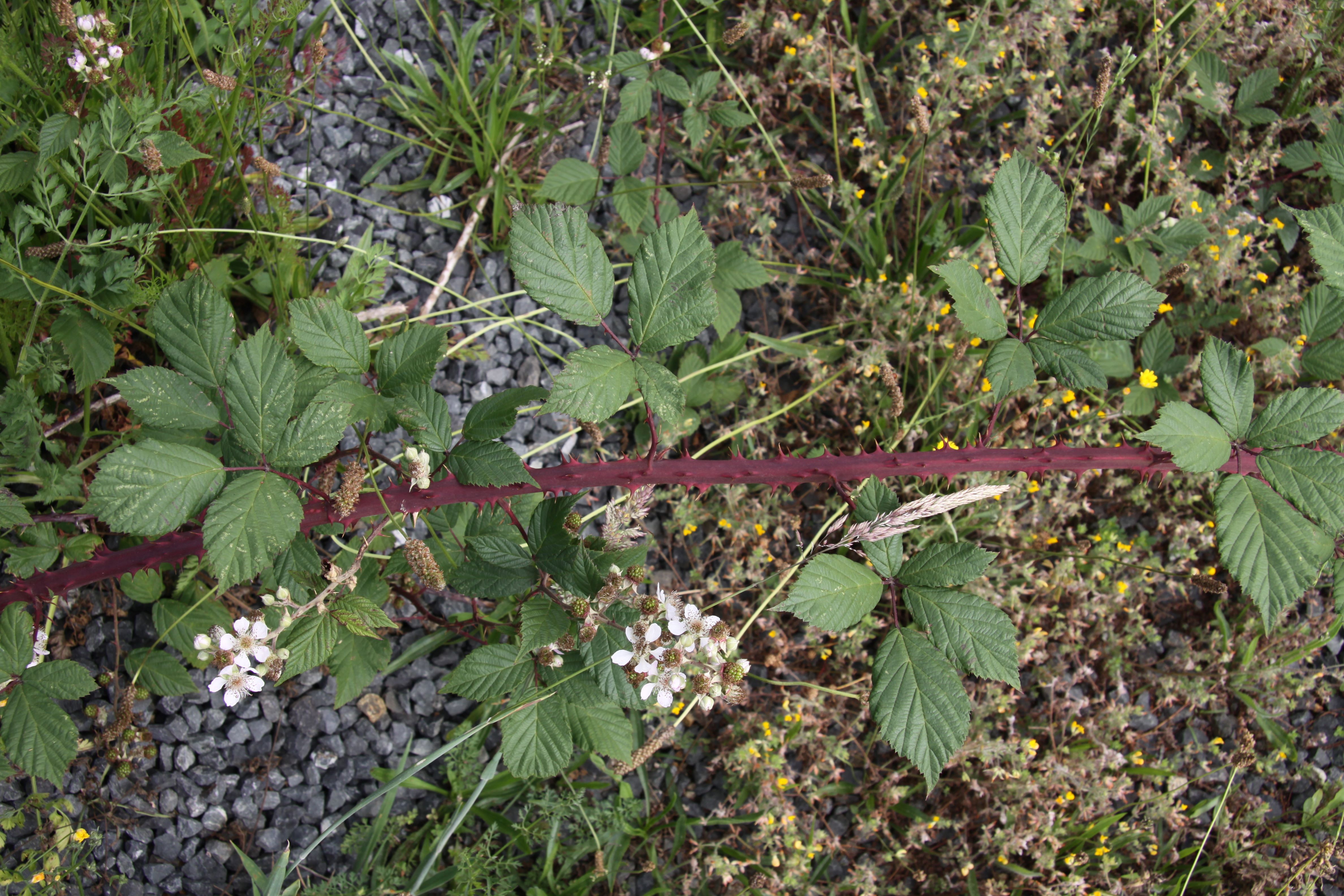
Blackberry
Rubus fruticosus

DESCRIPTION
Blackberry is a scrambling, thorny perennial shrub. It grows in dense thickets up to 2 metres tall, formed by the arching stems (canes) that are up to 7 metres long. Leaves are dark green with a lighter underside and are shed in the winter. Flowers are white to pink, and 20-30mm in diameter with five petals. The fruit is the familiar edible berry; initially green, then red ripening to black
The long canes can take root where they contact the ground, and the seeds are easily spread by birds, which often results in new infestations appearing around fences and stumps, where birds commonly perch.
Seedlings are initially slow-growing, but if allowed to persist will then rapidly develop into substantial thickets with a dense canopy. Blackberry thus not only chokes out pasture but also restricts stock access to streams and provides shelter for animal pests including rabbits and possums.
There are several varieties of blackberry in New Zealand, and some, especially in the East Coast and Northland regions, are more difficult to control with some herbicides.

MANUAL & MECHANICAL REMOVAL
Hand cutting is a feasible method for smaller patches, and isolated seedlings can also be grubbed out. Follow-up spot spraying is inevitably required where any material remains in the ground.
Rotary slashing, dozing and root-raking are all reasonable mechanical methods, but subsequent growth from any remaining root fragments will require spraying.
PASTURE & STOCK MANAGEMENT
Maintenance of good soil fertility and a vigorous pasture sward will reduce the establishment, or re-establishment, of blackberry. Grass seed should be sown on sites where old blackberry thickets were previously growing.
Goats will eat blackberry, although it is a long-term approach that will require adequate fencing to ensure that the goats must eat it, and also regular hand spraying of the grazed sites to complete the job. Goats may also need to be spelled into more feed-rich paddocks to maintain condition.
HERBICIDES TO CONTROL BLACKBERY
Herbicides Sprays to Kill Blackberry
Spraying is the preferred method of controlling blackberry, either as the sole treatment or in conjunction with mechanical removal, goat grazing, etc.
Blackberry is most vulnerable to herbicide sprays in the period of active growth, which occurs from flowering to early leaf fall. This may extend from late November through to the end of May, with the optimum window normally being from January to May. During this period the sap will be flowing freely back down to the roots as the bush builds up reserves for the following year, and this biological activity boosts the uptake and translocation of the herbicide to all parts of the plant.
When spraying, it’s vital to cover all parts of the plant including all lateral canes extending outside the main body of the thicket. Plants only partially covered will often die back but then rally and recover. The ideal best spray technique is to achieve thorough wetting of leaves to just short of run-off.
Important: Do NOT add a wetter/penetrant when spraying blackberry. Penetrants can cause the blackberry to drop its leaves before all of the herbicide has been taken up by the main parts of the plant.
- MSF600 at 300g/Ha by air, in 250L water.
- MSF600 at 35g/100L by handgun, knapsack 5g/10L.
- GrassMate at 10L/Ha, handgun 500ml/100L (600ml East Coast & Northland), knapsack 6ml/L.
- TRICLO Herbicide at 10L/Ha, handgun 500ml/100L (600ml East Cost & Northland), knapsack 6ml/L.
- G-360 GLYPHOSATE at 1.0-1.5L/100L by handgun. Knapsack 150ml/10L
- G-540 GLYPHOSATE at 700ml - 1L/100L by handgun. Knapsack 100ml/10L
- Granny Herbicide at 450g - 700g/100L. Knapsack 70g/10L
- GA200 at 500-750ml/100L by handgun, knapsack 50-75ml/10L
- GrassMate XTRA at 500-650ml/100L water by handgun or 10L/Ha by air
Notes:
- GrassMate is grass friendly. TRICLO Herbicide is grass and while better on clover than GrassMate it will still severly knock clover. MSF600 and Glyphosate are not grass or clover friendly, although ironically Glyphosate is not so good at killing clover.
- MSF600 is the slowest acting (takes several months) but the lowest cost. It’s also the most popular for spraying dense infestations.
- GA200 whilst non-selective, due to its mode of action is more suitable for spraying in and around orchards, natives, or where you have blackberry growing amongst non-target plants. You still need to take care though
Cut stem pastes or gels to Kill Blackberry
There are two main options:
- Cut’n’Paste Picloram Plus+ – its addition of aminopyralid improves uptake into suckers and improves long-term kill.
- Cut’n’Paste Glimax Gel
- Cut’n’Paste MetGel is also an option but the two above will likely perform better