Broad-leaved Fleabane
Conyza albida

DESCRIPTION
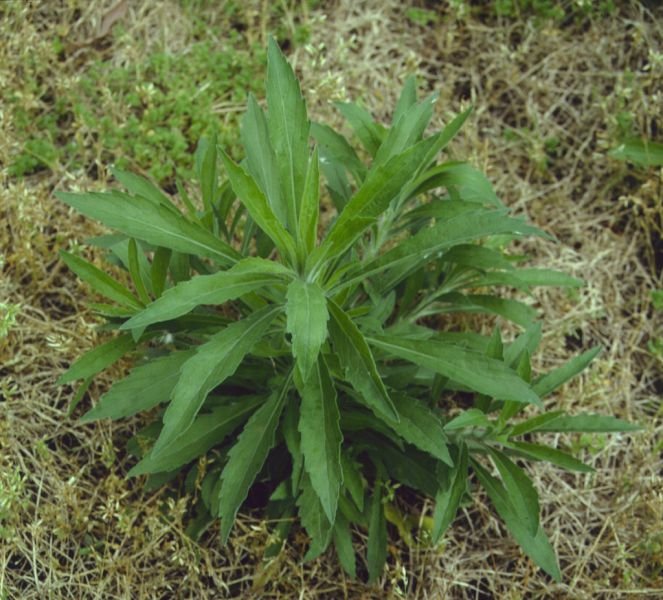
This is one of several fleabanes, but broad-leaved fleabane is the most common one in New Zealand. It’s usually an annual, but sometimes a biennial (i.e. taking 2 years rather than one to complete its life cycle). It’s common in the North Island, and the upper half of the South Island.
It grows to well over a metre high but starts out as a rosette that looks similar to hawksbeard and narrow-leaved plantain. The rosette leaves are distinguishable from those other species by having ‘teeth’ along the rosette leaf margins, pointing forward towards the leaf tip. The rosette leaves are narrow and pointed, and up to 12cm long and 2cm wide.
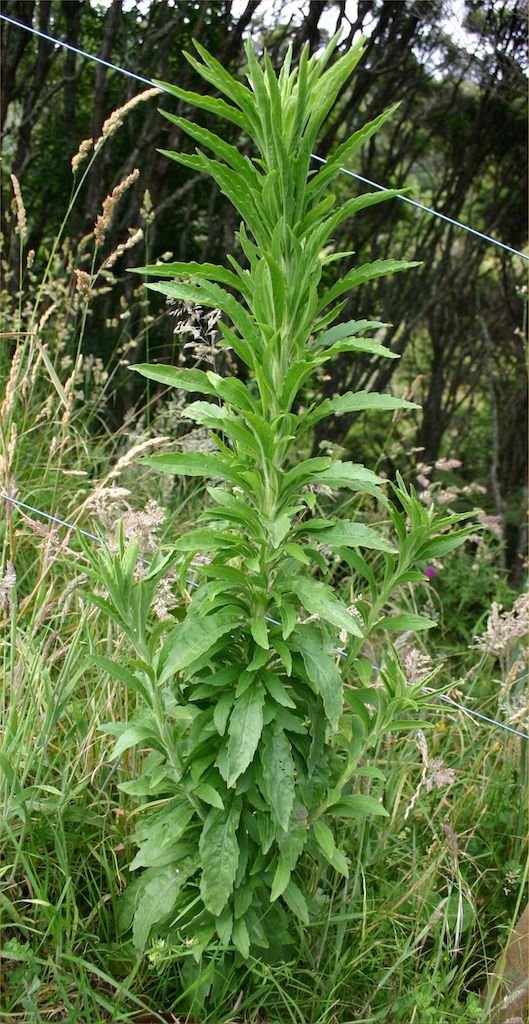
After the rosette stage, the plant produces very tall upright stems that branch near the top. The stems are hairy towards the top, less so lower down.
The small (2mm) yellow-white flowers appear densely about Jan-May on the upper half of the stems and then produce a great many small seeds each with a short fluffy ‘parachute’ or pappus that enables the seed to be widely distributed by wind action.
The seeds of the species are not good competitors, and dense pasture cover will usually prevent much germination there. But waste places, fence lines, roadsides and footpaths are all locations where broad-leaved fleabane can readily establish and multiply. Along fence lines, the erect stems can short out electric fences.
The species is less palatable once past the rosette stage, and when established at the erect stage, it’s not palatable to stock at all. That, combined with its prolific seeding, can result in a rapid infestation of broad-leaved fleabane in any location favourable to it.
MANUAL CONTROL
The erect stems can be successfully mowed to prevent seed set, but this is often not practical in favoured locations like fence lines and rougher waste areas.
In pasture the best non-chemical control method is to keep pastures dense, denying the fleabane seed an opportunity to germinate and establish successfully by virtue of out-competing it.
HERBICIDES TO CONTROL FLEABANE
Spot Spraying of herbicides to kill Fleabane
- G-360 GLYPHOSATE at 150ml/15 litres by knapsack, G-540 GLYPHOSATE at 100ml/15L, or 65g of Granny Herbicide per 15L. Not grass-friendly.
- GrassMate at 60ml per 15L of water. This is grass-friendly but will damage clover in the sprayed patches.
Boom Spraying Herbicides to Kill Fleabane
Should a major pasture infestation necessitate boom spraying, the best option is:
- WHACK – 2,4-D 800 at 1.7-3.4 L/hectare, against rosettes and small developing plants only. Will not control mature plants. Safe for established pasture grasses, but may suppress clover.
Herbicides to Kill Fleabane in Orchards & Vineyards
Glyphosate is effective, but unintended damage to susceptible trees and vines can be better avoided by instead using
- GA200 (glufosinate-ammonium) at 5-7L/Ha.
Cut'n'Paste Gels to control Fleabane
Use Cut'n'Paste Original Gel for Woody and Leafy weeds.